Climate communication in modern art – are the consequences of the problem represented enough?
By Pola Kepesz and Miyase Borcler (LK Englisch und Kunst, Q3)
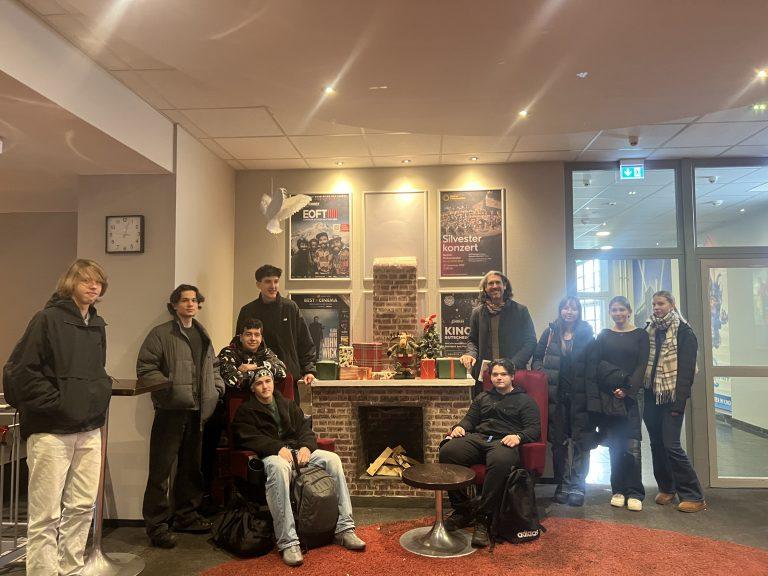
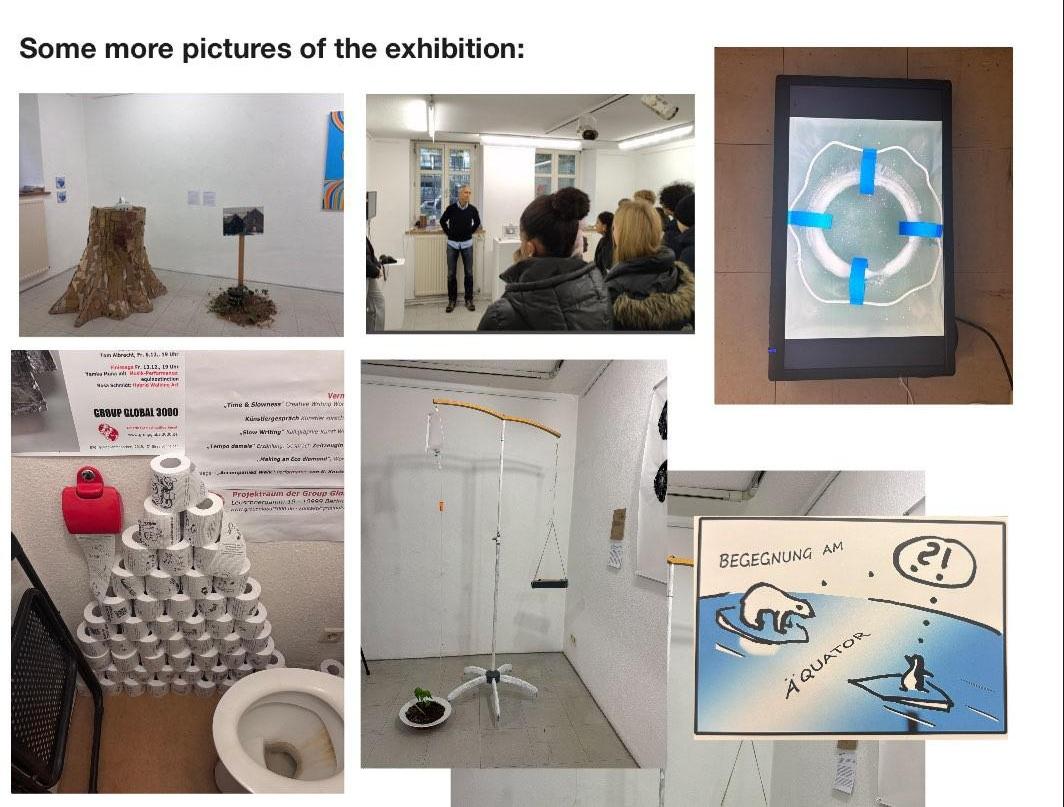
On the 17th of November the English and Art advance courses visited the gallery “Group Global 3000“ located at Leuschnerdamm 19, 10999 Berlin, showing the exhibition “Die Kunst der Klimakommunikation“. Spread over three small rooms, 24 pieces by 22 artists are exhibited.
René Knorr and the Curator Tom Albrecht gave us a tour introducing us to a mix of conceptual and object art.
Between paintings, various other forms of representation such as sculptures, prints, drawings and also visual art in form of video snippets and an interactive VR glass experience were included.
The exhibition partially gave us a new and more hopeful perspective on climate change which is much needed in our generation where we are confronted with the consequences every single day caused by every one of us.
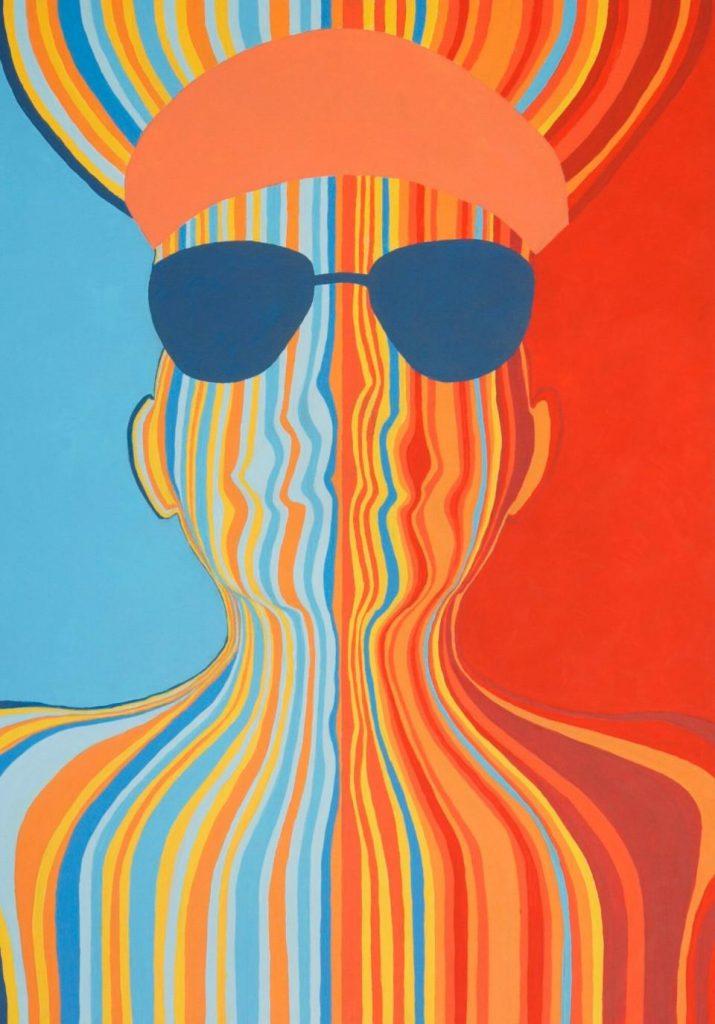
The representative face of the exhibition (literally) is “Generation +1,5 Degree Celcius“ by Jochen Czepa painted with acrylic on canvas in Berlin, 2024. It shows the colorful painting of a person. The face and body are consist of many wavy lines in bright colors like blue, yellow, orange, and red. The background is split into. The left side is light blue and the right side is bright red. The person is wearing dark blue sunglasses and an orange headband. The painting has a strong, bold style and stands out because of its bright colour contrast and symmetry. Each stripe represents the artist´s life and the annual climate warming in the span from 1955-2024. The data is based on statistics from the University of Berkeley.
This specific painting is a great example for the expansion and development of global warming going on since far before Gen Z´s time and the still much needed representation nowadays. While featuring bright colours and a memorable charisma it also has its downsides. What we mean by downsides is that colourful paintings often connect to positive emotions such as happiness or excitement. When it´s presented in contrast to earnestness it definitely displays a view on the hopeful side that humanity needs in order act, but if not it may not be taken as seriously as it should be or as it is wanted. This missing differentiation varies from exhibit to exhibit but can be seen in the following examples.
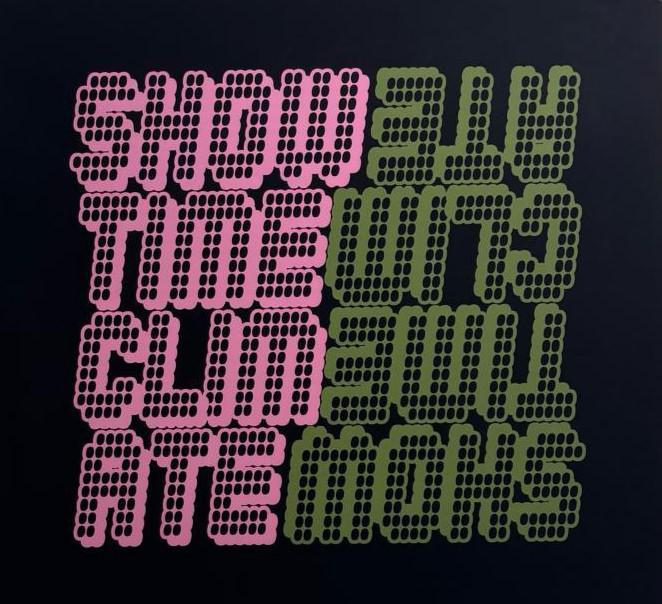
While the message is clear (climatediscourse in media) there is a lack of emotional impact climate issues are emotional and urgent. However, the typography remains distant and does not convey any sense of urgency, conflict, or much concern. Even though the caption invites the viewer to consider philosophical questions (what is real?, what is staged) the image itself offers very few visual clues to support such discussion. This artwork
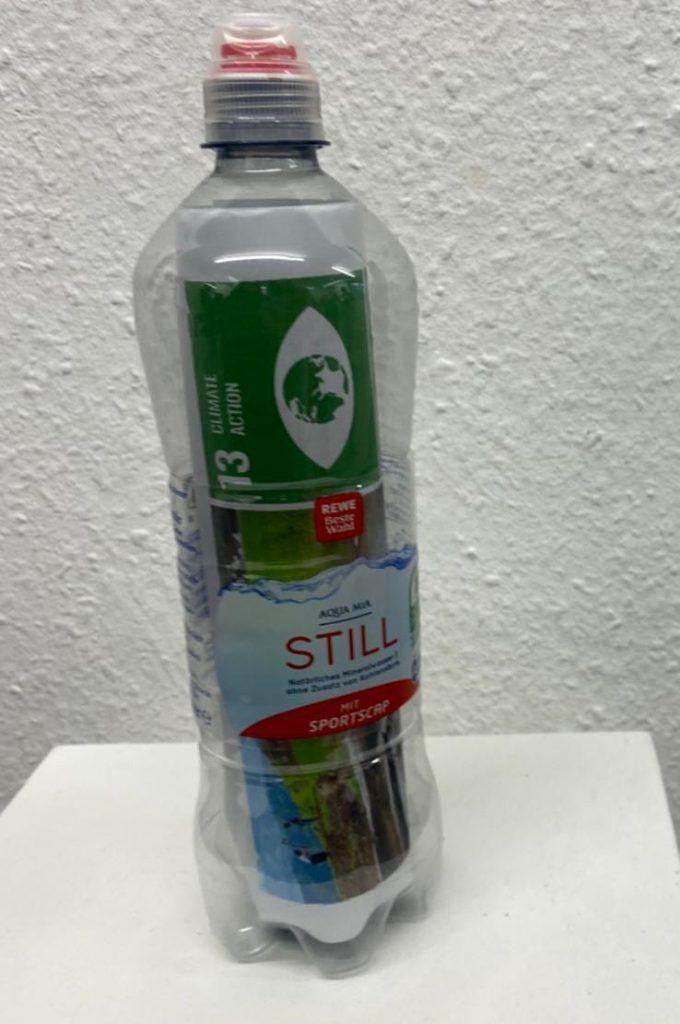
simply places a printed SDG (no. 13) poster inside a discarded plastic bottle. This direct combination feels more like a visual pun than a deeper commentary on climate protection. Sadly the climate message remains superficial. Although SDG 13 calls for urgent and global action, the artwork only gestures toward this complexity by inserting the printout into a bottle. It does not meaningfully explore the contradictions, challenges or systemic issues behind climate change. Even though the caption gives the written out form of SDG’s (Sustainable Developement Goals) by being rolled up and mainly showing the number of the significant SDG, it expects a certain kind of knowledge in advance not every visitor may have. This issue could have been solved for example by printing out the version of comibination from all SDG as an addition to the art piece to not only furthermore deepen the importance of all goals but to help other visitors to learn and understand what is meant by this exhibit.
Apart from the critical opinions our cources had, it is important to mention the insight we had into the highly discussed issue about tree felling in Berlin neighborhoods. This piece
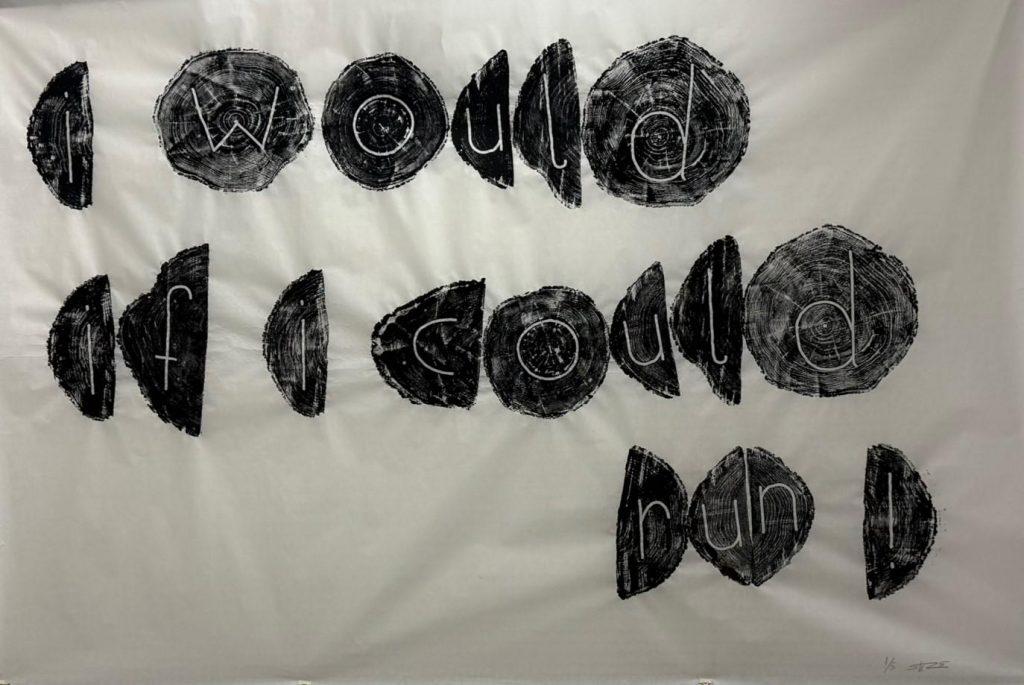
addreses excelently the controversy of tree felling by using a piece coming off from the notch cut (the cut in the tree to determine the direction into which the tree will fall) as printing stamp.The message “i would if i could run!“ can be interpret differently depending on the pronunciation (this is a little appeal to try it out before reading further). Focusing on the phrase “I would if I could”, it can be interpreted as an expression of a fundamentally human dilemma: while the intention to protect nature exists, our capacity to act on this responsibility remains limited. This limitation arises from psychological distance that the tendency to perceive environmental destruction as temporally, spatially, or socially remote. As a result, nature, despite being indispensable to human existence, is not experienced as an immediate concern, leading to a failure to protect it effectively.
Many people perceive environmental destruction such as deforestation, species extincion or climate change as something distant: “Happening somewhere else, to someone else, or in the future.“
Because these consequences might feel abstract, individuals struggle to feel directly responsible or urgently concerned. We think “I would act if i really had to“ but we fail to recognise that we already have to. When focusing on the background of the exhibit to say that the felled tree did not have the ability to flee is not too absurd. A tree is rooted, it can not move, run or protect itself from human decisions: Not from deforestation, construction projects or political decisions. Humans decide its fate without it having a say in that choice.
So the message critizises indirectly our assumption that nature is available for use simply because it cannot resist.
This reflection on human responsibility and the silent suffering of nature highlights a crucial point:
Climate communication must address not only what is visible, but also what remains overlooked or ignored. The exhibition itself does not mirror this problem enough. While some works expose the consequenses of environmental harm directly, like “Generation +1,5 Degree Celcius“ by Jochen Czepa or “ I would if I could“ by Stephan Kurr, others approach the climate crisis more symbolically or optimistically like „showtime climate“ or „Flaschenpost“ by Stephan Groß, leaving important aspects unspoken.
Our final words:
The consequences of climate change caused by us humans as earlier mentioned did unfortunately not find their place in this exhibition, it becomes evident that the artworks vary considerably in the way they frame and comnunicate the climate crisis. When asking why this certain negative but truthful perspective wasn’t chosen to be as represented, we were told that one criterion for being chosen as an artist in the plenum is that your art does not embody dystopia.
This is in our opinion exactly what is needed when talking about such a global topic regarding our future… regardless of the age.